
End of Abyss Beginner Guide: 9 Things to Know Before You Descend
End of Abyss beginner guide: 9 things to know before you descend — combat basics, scanner habits, scarce ammo, save pods, and suit mods.
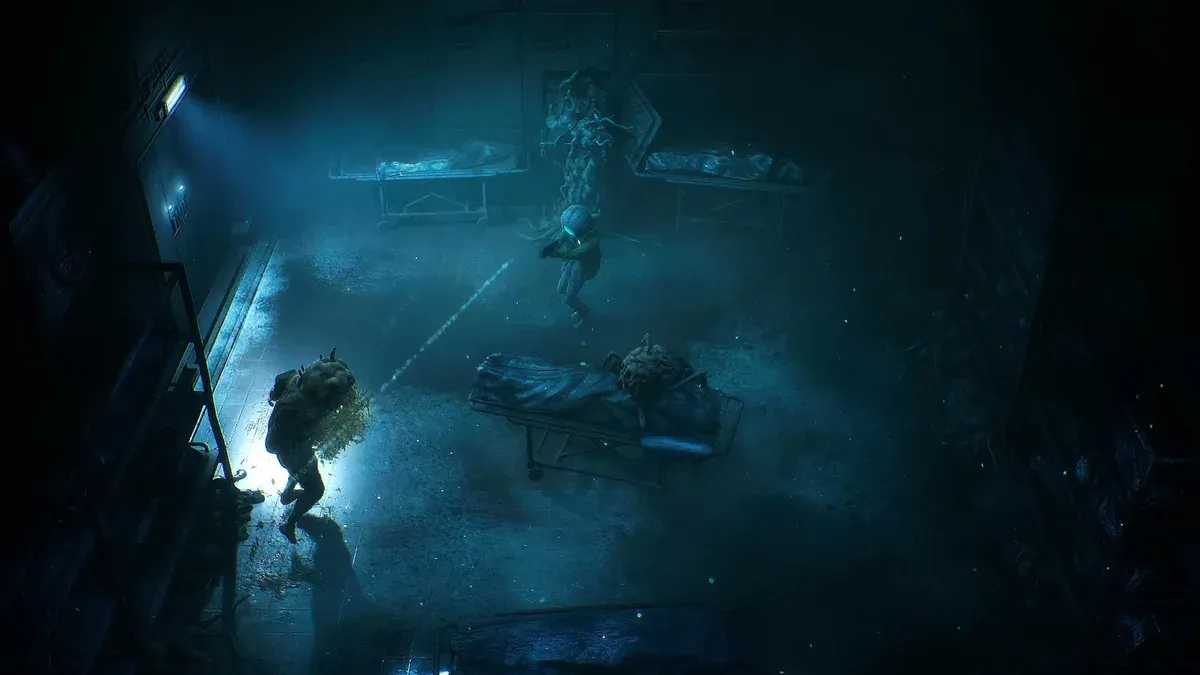
End of Abyss arrived October 1, 2026, and it does not hold your hand. This guide covers the nine things that most shape a first descent: what the game actually is, how its combat and scanner work, where its resources run dry, and how tough it really is — all confirmed against the launch build.

What kind of game is End of Abyss?
It is an atmospheric top-down 3D twin-stick shooter Metroidvania with sci-fi survival horror pacing, developed by Section 9 Interactive and published by Epic Games Publishing. The Malmö studio is staffed by the team behind Little Nightmares I and II at Tarsier, and the DNA shows: you play Cel, a young combat technician descending an underground facility that a parasitic entity has overtaken. The camera sits at a slightly tilted overhead angle, and the developers use that view as a horror tool — industrial metal, concrete, pipes, and sewers, all threaded with organic infestation. Cited inspirations include Alien, The Thing, Akira, Ghost in the Shell (the origin of the studio’s name), classic Metroid and Zelda, and Metal Gear Solid. It is a $29.99 single-player game — the platforms guide covers the PS5, Xbox Series X|S, and PC (Epic Games Store, no Steam) details, and Cel’s story collects what is known about the plot.
How does combat actually work?
Left stick moves, right stick aims a full 360 degrees, RT fires, and LT dodge-rolls — tight, responsive, and punishing. IGN’s source-based verdict was blunt: the combat is “absolutely no joke.” The Pulse Gun is the only weapon with unlimited ammunition; everything else in the kit runs dry. Read the full combat guide before your first descent — the dodge-roll matters more than any gun.
When should you use the scanner?
Constantly — treat scanning as a habit, not a menu option. The scanner is a dual-mode gadget swapped with the d-pad: sweep walls to reveal weaknesses and hidden spaces, sweep enemies for behavioral and tactical data. It also auto-tags locked doors on your map and hands you hints when you are stuck. In a game that hides its routes and punishes unprepared fights, the scanner is the single best survival tool you carry. The scanner guide breaks down both modes.
How scarce is ammo, really?
Scarce everywhere except the Pulse Gun. The pistol’s clip recharges, so you always have a baseline weapon. Riot Breaker shells are hard to come by and grenades are very limited, so treat both as problem-solving tools rather than routine firepower — shells and grenades spent on trash are shells and grenades you will not have when something big rounds the corner.
How do healing and death work?
Healing has limited uses and recharges at save pods; death respawns you nearby while the world remembers your progress. Doors you opened stay open and scans stay scanned — but monsters come back. Two practical takeaways: retreating to a save pod is a legitimate strategy when your heals are spent, and the progress you carve out survives your death, so a risky push is never entirely wasted.
How do crafting and upgrades gate progress?
Materials gathered from the environment and from enemies are spent at workbenches for ammo, gear, and weapon upgrades — and new equipment opens sealed areas. That is the Metroidvania loop: explore, collect, craft, then return to the doors you could not open. Destructible walls breached with Explosive Charges, ladders pulled down with the Grappling Hook, and growths burned with the Incinerator are all part of the traversal grammar. Keep track of what you have unlocked with the map guide.
Which enemies should worry you most?
The roster is varied, and the ones that punish sloppy shooting are the splitters and the healers. The facility’s transformed crew — Husks, Brutes, Latchers, and Infected Workers — plus burrowing leeches, hive insects, charging ball creatures, and the facility’s own hostile security robots fill the logbook’s 42 entries. Most important: some enemies split into multiple threats when damaged, and the scanner warns you which ones. Seven story bosses gate the descent — from the Husk Cluster to the two-phase Fractured Being — all catalogued in the all bosses directory.
How hard is it, honestly?
Tough but fair, consistently. IGN called the game “tough-as-nails”; GameSpot’s headline was “Fantastic (And Hard)”. Previewers agree the difficulty comes from enemy pressure and resource scarcity, not cheap shots — attacks are readable, and the dodge-roll always works when you time it. The difficulty guide sets expectations in full.
What should you read before your first descent?
The fundamentals first, then the systems, then the descent. Our suggested reading order:
- Combat guide — controls, weapons, and dodge-roll discipline.
- Scanner guide — the gadget you will use more than any weapon.
- Weapons overview — the full six-weapon arsenal and where each hides.
- Walkthrough — the critical path, part by part, when you need it.
- Suit mods and energy cells — the passive-build side of progression.
- How long to beat — what the descent costs in hours.
Sources
This article was compiled with AI assistance and checked by the site operator against the sources linked on this page — it is not based on first-hand play. Last checked: 10/14/2026. Editorial policy
Related Articles
End of Abyss Fractured Being: Final Boss Strategy (Both Phases)
Fractured Being final boss guide: phase 1 melee, grab and gravity attacks, phase 2 tendrils and shockwave — plus the stagger trick that trivializes its pull.
Last checked Oct 14
End of Abyss Suit Mods: All 10 Mods, 8 Vaults & 6 Energy Cells
Every suit mod, vault, and Energy Cell in End of Abyss — where all 10 mods and 8 Vault Keys are, plus the 6 Energy Cells that unlock extra mod slots.
Last checked Oct 14
End of Abyss Incinerator: Story Unlock, Uses, and Burnable Walls
The Incinerator is the flamethrower found in the Lower Levels — required for the story, lethal against the Failed Experiment, and the key to burnable secrets.
Last checked Oct 14
Was this helpful?
Thanks for the feedback!